Support Vector Regression–Based Model for Multizone Electricity Consumption Forecasting
##plugins.themes.academic_pro.article.sidebar##
Downloads
##plugins.themes.academic_pro.article.main##
Abstract
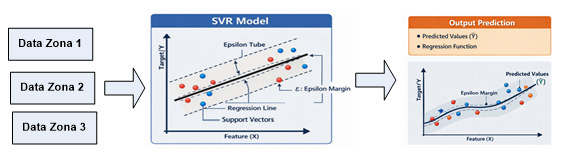
This study aims to develop and evaluate a multi-zone short-term electricity consumption prediction model based on weather factors using the Support Vector Regression (SVR) method to support more efficient and adaptive power system planning in response to climate variability. Ten-minute resolution electricity consumption data from three zones was combined with variables of air temperature, relative humidity, wind speed, and solar radiation. The research process included data preprocessing, temporal feature engineering, time-based data partitioning, and SVR hyperparameter optimization with RBF kernel. Model performance was evaluated using Root Mean Square Error (RMSE), Mean Absolute Error (MAE), and coefficient of determination (R²) metrics, and compared with reference models such as linear regression, Random Forest Regression, and Artificial Neural Network. The results of the experiment show that SVR provides the best accuracy at high temporal resolution. At 10-minute aggregation, the MAPE values obtained were 4.78% (Zone 1), 4.11% (Zone 2), and 9.25% (Zone 3). Model performance declines as the level of time aggregation increases, indicating that the effectiveness of SVR is influenced by the temporal scale and load characteristics of each zone. These findings show that SVR works effectively for weather-based electricity load forecasting in various zones at high temporal resolution, although its performance declines at larger aggregation scales.
Keywords: Multizone electric power consumption; Short-term load forecasting; Weather/meteorological factors; Support Vector Regression (SVR); Intelligent energy management systems.
##plugins.themes.academic_pro.article.details##

This work is licensed under a Creative Commons Attribution-NonCommercial 4.0 International License.
References
[2] M. T. Noorzai, A. Bełdycka-Bórawska, A. Kutlar, T. Rokicki, and P. Bórawski, “Exploring the Link Between Energy Consumption, Economic Growth, and Ecological Footprint in the Major Importers of Poland Energy: A Panel Data Analysis,” Energies, vol. 18, no. 13, pp. 1–26, 2025, doi: 10.3390/en18133303.
[3] S. K. Panda, “Electrical load and solar power forecasting using machine learning techniques,” J. King Saud Univ. - Eng. Sci., vol. 37, no. 4, 2025, doi: 10.1007/s44444-025-00012-y.
[4] S. Akhtar, M. Adeel, M. Iqbal, A. Namoun, A. Tufail, and K. H. Kim, “Deep learning methods utilization in electric power systems,” Energy Reports, vol. 10, pp. 2138–2151, 2023, doi: 10.1016/j.egyr.2023.09.028.
[5] M. Pournabi, M. Mohammadi, S. Afrasiabi, and P. Setoodeh, “Power system transient security assessment based on deep learning considering partial observability,” Electr. Power Syst. Res., vol. 205, no. December 2021, p. 107736, 2022, doi: 10.1016/j.epsr.2021.107736.
[6] Y. Jia, S. Zhou, Y. Wang, F. Lin, and Z. Gao, “A quadratic ν-support vector regression approach for load forecasting,” Complex Intell. Syst., vol. 11, no. 1, pp. 1–12, 2025, doi: 10.1007/s40747-024-01730-7.
[7] L. O. M. Yusuf, S. Handoko, and I. Setiawan, Forecasting Short-Term Electrical Loads Using Support Vector Regression with Gaussian Kernel Functions. Atlantis Press International BV, 2023.
[8] Y. Chen et al., “Short-term electrical load forecasting using the Support Vector Regression (SVR) model to calculate the demand response baseline for office buildings,” Appl. Energy, vol. 195, pp. 659–670, 2017, doi: 10.1016/j.apenergy.2017.03.034.
[9] J. Duan, X. Tian, W. Ma, X. Qiu, P. Wang, and L. An, “Electricity consumption forecasting using support vector regression with the mixture maximum correntropy criterion,” Entropy, vol. 21, no. 7, 2019, doi: 10.3390/E21070707.
[10] Z. Zhang, Q. Zhang, H. Liang, and B. Gorbani, “Optimizing electric load forecasting with support vector regression/LSTM optimized by flexible Gorilla troops algorithm and neural networks a case study,” Sci. Rep., vol. 14, no. 1, pp. 1–20, 2024, doi: 10.1038/s41598-024-73893-9.
[11] R. Shang and Y. Ma, “Electric Vehicle Charging Load Forecasting Based on K-Means++-GRU-KSVR,” World Electr. Veh. J., vol. 15, no. 12, 2024, doi: 10.3390/wevj15120582.
[12] X. Xiang, X. Li, Y. Zhang, and J. Hu, “A short-term forecasting method for photovoltaic power generation based on the TCN-ECANet-GRU hybrid model,” Sci. Rep., vol. 14, no. 1, pp. 1–12, 2024, doi: 10.1038/s41598-024-56751-6.
[13] Y. Sun and S. Zhang, “A Multiscale Hybrid Wind Power Prediction Model Based on Least Squares Support Vector Regression–Regularized Extreme Learning Machine–Multi-Head Attention–Bidirectional Gated Recurrent Unit and Data Decomposition,” Energies , vol. 17, no. 12, 2024, doi: 10.3390/en17122923.
[14] S. H. Moon, D. Y. Kim, and Y. H. Kim, “Post-Processing Maritime Wind Forecasts from the European Centre for Medium-Range Weather Forecasts around the Korean Peninsula Using Support Vector Regression and Principal Component Analysis,” J. Mar. Sci. Eng., vol. 12, no. 8, 2024, doi: 10.3390/jmse12081360.
[15] C. K. Kim, M. H. Yoon, and S. Lee, Robust control chart for nonlinear conditionally heteroscedastic time series based on Huber support vector regression, vol. 19, no. 2 February. 2024.
[16] S. Sitara, W. Fatima, and A. Rahimi, “A Review of Time-Series Forecasting Algorithms for Industrial,” mdpi, 2024.