Phased Implementation Design of the E-SETGO Framework in Real-World Software Development Projects: A Low Hanging Fruit Strategy for Higher Education Institutions
##plugins.themes.academic_pro.article.sidebar##
Downloads
##plugins.themes.academic_pro.article.main##
Abstract
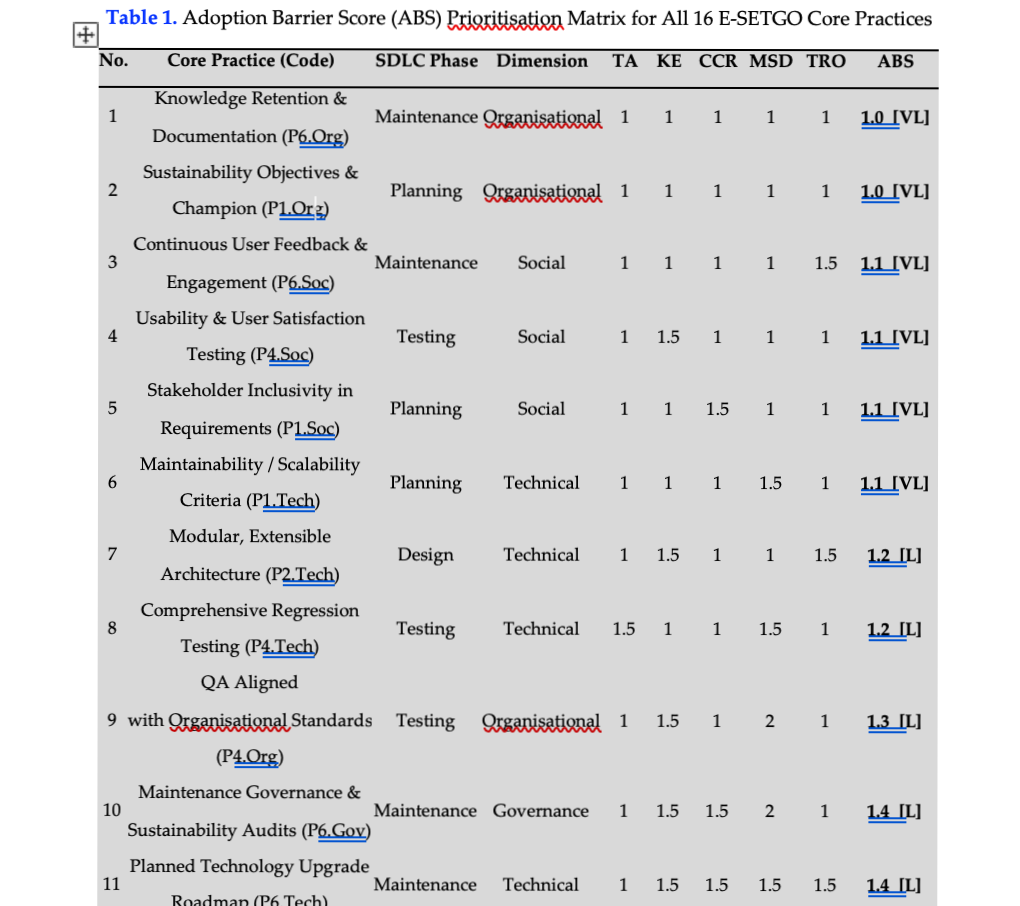
The information and communication technology (ICT) sector contributes approximately 4% of global greenhouse gas (GHG) emissions, with projections indicating a rise to 8% by 2030, a structural paradox given that software systems are simultaneously recognised as critical enablers for all 17 United Nations Sustainable Development Goals (SDGs). The E-SETGO framework, validated through expert consensus using Lawshe's Content Validity Ratio (CVR) with a nine-expert panel, provides 16 core and 8 conditional sustainable software development practices integrated across six Software Development Life Cycle (SDLC) phases, with a comprehensive SDG contribution mapping. However, a critical empirical gap persists: no published study has operationalised how these practices can be progressively adopted in real organisational contexts. This paper addresses that gap by proposing a phased implementation design grounded in the low hanging fruit principle, systematically prioritising practices with the lowest organisational adoption barriers for initial deployment. Employing Design Science Research (DSR) methodology, two complementary real-world software projects at Institut Teknologi PLN (ITPLN) are selected: the AMORA management information system serving as a maintenance-phase Learning Laboratory, and the Distance Learning (PJJ) Learning Management System serving as a green-field Main Case Study. A five-dimension Adoption Barrier Score (ABS) prioritisation matrix is developed across all 16 core practices, identifying P6.Org (Knowledge Retention), P1.Org (Sustainability Objectives and Champion) and P6.Soc (Continuous User Feedback) as universal immediate-adoption candidates with ABS scores of 1.0. A dual pilot strategy, 12-month phased implementation timeline, four validated data collection instruments, and a pre-mapped SDG contribution framework are designed for subsequent empirical validation. The design is projected to contribute to SDG 4, 8, 9, 10, 16 and 17 through direct and enabling contribution mechanisms.
##plugins.themes.academic_pro.article.details##

This work is licensed under a Creative Commons Attribution-NonCommercial 4.0 International License.
References
[2] United Nations, "Transforming our world: The 2030 agenda for sustainable development," Resolution A/RES/70/1, United Nations General Assembly, New York, NY, USA, 2015.
[3] N. Condori-Fernandez and P. Lago, "Characterising the contribution of quality requirements to software sustainability," J. Syst. Softw., vol. 137, pp. 289-305, Mar. 2018, doi: 10.1016/j.jss.2017.12.005.
[4] R. Chitchyan et al., "Sustainability design in requirements engineering: State of practice," in Proc. 38th Int. Conf. Softw. Eng. Companion (ICSE-C), Austin, TX, USA, May 2016, pp. 533-542, doi: 10.1145/2889160.2889217.
[5] N. Condori-Fernandez and P. Lago, "A systematic mapping study on the contributions of software engineering to sustainability," J. Syst. Softw., vol. 119, pp. 84-106, Sep. 2016, doi: 10.1016/j.jss.2016.05.042.
[6] H. Koziolek, R. Heinrich, R. Reussner, and R. Mirandola, "Sustainable software architecture: A systematic literature review," Inf. Softw. Technol., vol. 159, p. 107203, Jul. 2023, doi: 10.1016/j.infsof.2023.107203.
[7] F. Firmansyah and I. Nugraheni Dinar Mutiara Kusumo and Waspada, “Integrating Sustainability into Software Development Life Cycle: A Six-Dimensional Framework and Expert Validation,” International Journal of Intelligent Engineering and Systems, vol. 19, no. 5, pp. 964–984, 2026, doi: 10.22266/ijies2026.0531.55.
[8] F. Firmansyah, D. M. K. N. Nugraheni, and I. Waspada, "Mapping sustainable software development practices to UN sustainable development goals: An evidence-based approach," Int. J. Intell. Eng. Syst., vol. 18, no. 1, 2025.
[9] C. Betz, C. Sorensen, and K. Beck, "Sustainability in software engineering: Practitioners' perspectives on adoption barriers," IEEE Softw., vol. 39, no. 4, pp. 78-86, Jul./Aug. 2022, doi: 10.1109/MS.2022.3153891.
[10] A. R. Hevner, S. T. March, J. Park, and S. Ram, "Design science in information systems research," MIS Q., vol. 28, no. 1, pp. 75-105, Mar. 2004, doi: 10.2307/25148625.
[11] J. vom Brocke, A. Hevner, and A. Maedche, "Introduction to design science research," in Design Science Research: Cases, J. vom Brocke, A. Hevner, and A. Maedche, Eds. Cham, Switzerland: Springer, 2020, pp. 1-13, doi: 10.1007/978-3-030-46781-4_1.
[12] P. Lago, "Architecture design decision maps for software ecosystem sustainability," in Proc. 39th Int. Conf. Softw. Eng.: Software Engineering in Society (ICSE-SEIS), Buenos Aires, Argentina, May 2017, pp. 61-64, doi: 10.1109/ICSE-SEIS.2017.6.
[13] C. Venters et al., "Software sustainability: Research and practice from a software architecture viewpoint," J. Syst. Softw., vol. 138, pp. 174-188, Apr. 2018, doi: 10.1016/j.jss.2017.12.026.
[14] Institut Teknologi PLN, "Accreditation document: Distance learning undergraduate program in mechanical engineering (PJJ S1 Teknik Mesin)," Rectorate ITPLN, Jakarta, Indonesia, Internal Document, 2026.
[15] E. M. Rogers, Diffusion of Innovations, 5th ed. New York, NY, USA: Free Press, 2003.
[16] C. Allen, G. Metternicht, and T. Wiedmann, "Prioritising SDG targets: Assessing baselines, gaps and interlinkages," Sustainability Science, vol. 14, no. 2, pp. 421-438, 2019, doi: 10.1007/s11625-018-0596-8.
[17] R. K. Yin, Case Study Research and Applications: Design and Methods, 6th ed. Los Angeles, CA, USA: SAGE Publications, 2018.
[18] B. Penzenstadler and H. Femmer, "A generic model for sustainability with process- and product-specific instances," in Proc. Workshop Green and Sustainable Software (GREENS), San Francisco, CA, USA, 2013, pp. 3-10, doi: 10.1109/GREENS.2013.6606416.
[19] P. Lago, P. Avgeriou, and B. Penzenstadler, "Green and sustainability in software engineering," J. Syst. Softw., vol. 119, pp. 1-3, Sep. 2016, doi: 10.1016/j.jss.2016.05.041.
[20] A. S. Andrae and T. Edler, "On global electricity usage of communication technology: Trends to 2030," Challenges, vol. 6, no. 1, pp. 117-157, 2015, doi: 10.3390/challe6010117.
[21] F. Calero and M. Piattini, "Introduction to green in software engineering," in Green in Software Engineering, F. Calero and M. Piattini, Eds. Cham, Switzerland: Springer, 2015, pp. 3-27, doi: 10.1007/978-3-319-08581-4_1.
[22] C. Wohlin et al., Experimentation in Software Engineering. Berlin, Germany: Springer, 2012, doi: 10.1007/978-3-642-29044-2.
[23] N. Seyff, I. Groher, and G. Bauer, "Exploration of sustainability requirements patterns and their relationships to the SDGs," in Proc. IEEE 30th Int. Requirements Engineering Conf. (RE), Melbourne, Australia, Aug. 2022, pp. 52-62, doi: 10.1109/RE54965.2022.00015.
[24] M. Sjoberg, A. Dyba, and J. E. Hannay, "The future of empirical methods in software engineering research," in Proc. IEEE Future of Software Engineering (FOSE), Washington, DC, USA, 2007, pp. 358-378, doi: 10.1109/FOSE.2007.30.
[25] K. H. Lawshe, "A quantitative approach to content validity," Personnel Psychology, vol. 28, no. 4, pp. 563-575, 1975, doi: 10.1111/j.1744-6570.1975.tb01393.x.