Pengolahan Limbah Air Kelapa Menjadi Nata De Coco: Pemberdayaan Ekonomi Berbasis Lingkungan di Desa Karya Maju Kecamatan Pengabuan Tanjung Jabung Barat
##plugins.themes.academic_pro.article.sidebar##
Downloads
##plugins.themes.academic_pro.article.main##
Abstract
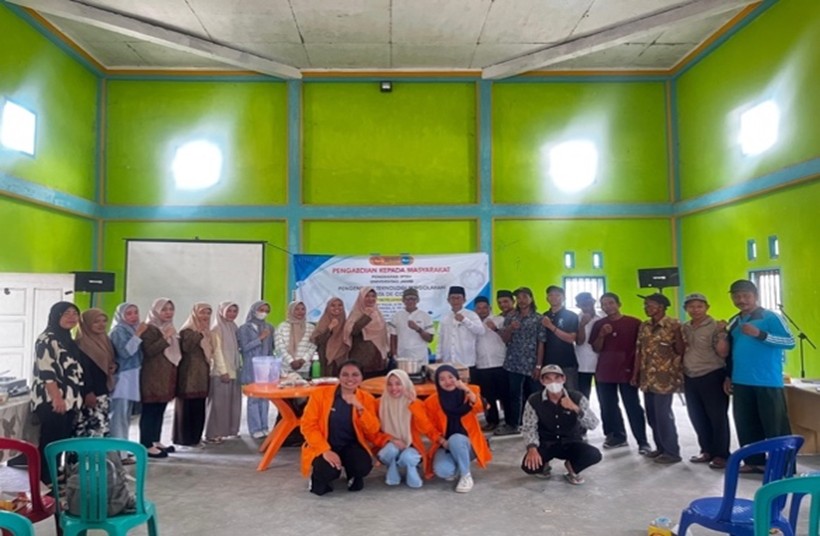
Kecamatan Pengabuan di Kabupaten Tanjung Jabung Barat memiliki potensi besar dalam memanfaatkan hasil samping kelapa, khususnya air kelapa yang selama ini terbuang. Desa Karya Maju, dengan luas perkebunan kelapa 1.673 hektar dan produktivitas tahunan 2.112,3 ton, berfokus pada produksi kopra, sementara air kelapa sebagai by-product tidak dimanfaatkan. Program inovatif ini mengubah air kelapa menjadi nata de coco, produk pangan bernilai ekonomi dan kaya serat hasil fermentasi bakteri Acetobacter xylinum. Melalui pelatihan, sosialisasi, dan demonstrasi yang diikuti oleh kelompok tani lokal, para petani kini mendapat wawasan dan keterampilan baru dalam mengolah limbah menjadi produk unggulan desa. Dengan potensi produksi nata de coco hingga 422,46 ton per tahun, program ini berkontribusi dalam peningkatan ekonomi masyarakat melalui produk berdaya saing. Program ini mendukung visi “Ekonomi Kerakyatan Berbasis Produk Unggulan Desa” dan mengangkat nata de coco sebagai produk andalan Pengabuan.
##plugins.themes.academic_pro.article.details##

This work is licensed under a Creative Commons Attribution-NonCommercial 4.0 International License.
JURPIKAT (Jurnal Pengabdian Kepada Masyarakat) accepts manuscripts that have not been published elsewhere and are not under consideration for publication by other print or electronic media. Authors retain copyright and grant the journal right of first publication with the work simultaneously licensed under a Creative Commons BY-NC License that allows others to share the work with an acknowledgment of the work's authorship and initial publication in this journal.
Authors are able to enter into separate, additional contractual arrangements for the non-exclusive distribution of the journal's published version of the work (eg, post it to an institutional repository, in a journal or publish it in a book), with an acknowledgment of its initial publication in this journal.
License to Publish
The non-commercial use of the article will be governed by the Attribution-NonCommercial 4.0 International (CC BY-NC 4.0). The author hereby grants JURPIKAT (Jurnal Pengabdian Kepada Masyarakat) an exclusive publishing and distribution license in the manuscript include tables, illustrations or other material submitted for publication as part of the manuscript (the “Articleâ€) in print, electronic and all other media (whether now known or later developed), in any form, in all languages, throughout the world, for the full term of copyright, and the right to license others to do the same, effective when the article is accepted for publication. This license includes the right to enforce the rights granted hereunder against third parties.
References
Agustine, R., Siti D.I., dan Hastuti, E. 2014. Pemanfaatan Adsorben Nata De Coco Untuk Pengolahan Air Tercemar Logam Berat Cu, Cd, dan Cr Skala Laboratorium. Jurnal Permukiman. 9 (3) : 129-135.
Andriyani, L. D. 2017. Analisis Kelayakan Industri Rumah Tangga Nata de Coco di Kabupaten Bantul. Skripsi. Universitas Muhammadiyah Yogyakarta. Yogyakarta.
Badan Pusat Statistik Kabupaten Tanjung Jabung Barat. 2020. Kecamatan Pengabuan Dalam Angka 2020. Badan Pusat Statistik Kabupaten Tanjung Jabung Barat.
Barlina, R., Suryani, L., Manaroinsong. 2018. Pengolahan Edible Film Nata de Coco dan Aplikasinya sebagai Coating pada Daging Kelapa Muda. Buletin Palma. 19 (2) : 57 – 68.
Hamad, A., Andriyani, N. A., Wibisono, H., & Sutopo, H. (2011). Pengaruh penambahan sumber karbon terhadap kondisi fisik nata de coco. Techno (Jurnal Fakultas Teknik, Universitas Muhammadiyah Purwokerto). 12 (2): 74-44 https://doi.org/10.30595/techno.v12i2.34
Hasanuddin, H., Dewi, K. H., & Wulandra, O. (2012). The use of coconut water for raw material of vinegar. Jurnal Agroindustri, 2(2), 53–61. https://doi.org/10.31186/j.agroindustri.2.2.53-61
Iguchi, M., Yamaka, S., Dan Budhiono, A. 2000. Bacterial cellulose a masterpiece of nature's arts. Journal of Material Science 3(5) : 261 - 270.
Kementerian Lingkungan Hidup. (2014). Peraturan Menteri Lingkungan Hidup Nomor 5 Tahun 2014 tentang Baku Mutu Air Limbah. Jakarta: Kementerian Lingkungan Hidup.
Ketaren, S. 1986. Pengantar Teknologi Minyak dan Lemak. UI-Press. Jakarta.
Kumbar, D., Yadav, N. K., Kumar, V., Komatineni, B. K., & Gundgavi, P. M. (2023). Determination of physico-chemical characteristics of waste coconut water. International Journal of Agricultural Sciences, 19(2), 654–656. https://doi.org/10.15740/HAS/IJAS/19.2/654-656
Ngoc, T. N. T., Masniyom, P., & Maneesri, J. (2016). Preparation of vinegar from coconut water using baker’s yeast and acetobacter aceti TISTR 102 starter powder. Asia-Pacific Journal of Science and Technology, 21(2), 385–396. https://doi.org/10.14456/kkurj.2016.42
Shi, S., Wang, W., Wang, F., Yang, P., Yang, H., He, X., & Liao, X. (2025). Research progress in coconut water: A review of nutritional composition, biological activities, and novel processing technologies. Foods, 14(9), Article 1503. https://doi.org/10.3390/foods14091503
Thankappan, G., & Anitha, P. (2018). Effect of sources of coconut water and acidulants on physico-chemical properties of nata-de-coco. Journal of Tropical Agriculture
Yulia, A., Yernisa, dan Oktaria, F. 2021. Analisis Kelayakan Usaha Pengolahan Limbah Buah Pinang dan Buah Kelapa Di Kecamatan Pengabuan Kabupaten Tanjung Jabung Barat Jambi. Laporan Kemajuan Penelitan. Fakultas Teknologi Pertanian. Universitas Jambi.