Inovasi Material Komposit untuk Mendukung Wawasan Teknologi Otomotif Mahasiswa Vokasi melalui Kuliah Tamu
##plugins.themes.academic_pro.article.sidebar##
Downloads
##plugins.themes.academic_pro.article.main##
Abstract
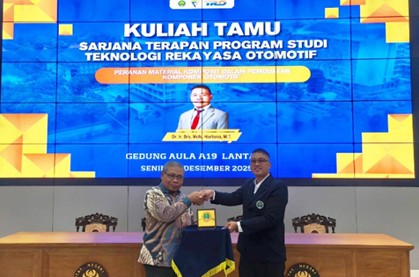
Perkembangan teknologi otomotif mendorong kebutuhan material yang ringan, kuat, aman, efisien, dan berkelanjutan. Kegiatan pengabdian ini bertujuan memperluas wawasan mahasiswa vokasi mengenai karakteristik, keunggulan, dan penerapan material komposit pada komponen otomotif melalui kuliah tamu. Kegiatan dilaksanakan oleh Program Studi Teknologi Rekayasa Otomotif Fakultas Vokasi Universitas Negeri Malang melalui tahapan identifikasi kebutuhan, penyampaian materi pakar, diskusi interaktif, dan evaluasi. Sebanyak 30 peserta mengisi 10 butir angket menggunakan skala Likert 1–5. Hasil evaluasi menunjukkan rata-rata skor 4,42 dengan kategori sangat baik. Kegiatan berkontribusi terhadap pemahaman mahasiswa mengenai inovasi material, penerapannya pada komponen otomotif, serta kaitannya dengan efisiensi energi dan keberlanjutan.
##plugins.themes.academic_pro.article.details##

This work is licensed under a Creative Commons Attribution-NonCommercial 4.0 International License.
JURPIKAT (Jurnal Pengabdian Kepada Masyarakat) accepts manuscripts that have not been published elsewhere and are not under consideration for publication by other print or electronic media. Authors retain copyright and grant the journal right of first publication with the work simultaneously licensed under a Creative Commons BY-NC License that allows others to share the work with an acknowledgment of the work's authorship and initial publication in this journal.
Authors are able to enter into separate, additional contractual arrangements for the non-exclusive distribution of the journal's published version of the work (eg, post it to an institutional repository, in a journal or publish it in a book), with an acknowledgment of its initial publication in this journal.
License to Publish
The non-commercial use of the article will be governed by the Attribution-NonCommercial 4.0 International (CC BY-NC 4.0). The author hereby grants JURPIKAT (Jurnal Pengabdian Kepada Masyarakat) an exclusive publishing and distribution license in the manuscript include tables, illustrations or other material submitted for publication as part of the manuscript (the “Articleâ€) in print, electronic and all other media (whether now known or later developed), in any form, in all languages, throughout the world, for the full term of copyright, and the right to license others to do the same, effective when the article is accepted for publication. This license includes the right to enforce the rights granted hereunder against third parties.
References
Czerwinski, F. (2021). Current trends in automotive lightweighting strategies and materials. Materials, 14. https://doi.org/10.3390/ma14216631
Daver, F., & Hadgraft, R. (2013). “Automotive materials” education: Linking materials science to design and manufacturing challenges in the automotive industry. Journal of Materials Education, 35, 71–78.
Fredriksson, C., & Ekergård, B. (2024). Material selection in electric vehicle engineering programs. 2022 ASEE Annual Conference & Exposition Proceedings. https://doi.org/10.18260/1-2--41527
Gonçalves, M., Monteiro, H., & Iten, M. (2022). Life cycle assessment studies on lightweight materials for automotive applications: An overview. Energy Reports. https://doi.org/10.1016/j.egyr.2022.01.067
Jafari, F., & Redden, L. W. (2024). Incorporating industry professionals as guest speakers in construction management programs: Enhancing knowledge and learning experiences. EPiC Series in Built Environment. https://doi.org/10.29007/5thh
Kinane, C., Tyler, K., Taub, A. I., & Pena-Francesch, A. (2024). Sustainable materials design in undergraduate engineering education. 2023 ASEE Annual Conference & Exposition Proceedings. https://doi.org/10.18260/1-2--44390
Mohammadi, H., Ahmad, Z., Mazlan, S., Johari, M. A. F., Siebert, G., Petrů, M., & Koloor, S. R. R. (2022). Lightweight glass fiber-reinforced polymer composite for automotive bumper applications: A review. Polymers, 15. https://doi.org/10.3390/polym15010193
Murčinková, Z., & Krenický, T. (2025). Composites and lattice structured materials as innovations of courses in study programs of mechanical engineering. International Journal of Higher Education Pedagogies. https://doi.org/10.33422/ijhep.v6i2.942
Pawar, A., Dhapte-Pawar, V., & Gaikwad, V. (2021). Interactive teaching in higher education for effective knowledge dissemination and improved student participation. Indian Journal of Pharmaceutical Education and Research. https://doi.org/10.5530/ijper.55.3s.173
Pepple, D., Akaighe, G., Sambo, A., George-Aremu, O., Bosah, G., & Trollman, H. (2025). Using guest lectures to enhance student employability: Pedagogical considerations. Cogent Education, 12. https://doi.org/10.1080/2331186x.2025.2452076
Risaliti, E., Gabriele, A., Del Pero, F., & Citti, P. (2025). Innovative model for material selection within the automotive lightweight eco-design field. AIAS 2024. https://doi.org/10.3390/engproc2025085020
Rutagangibwa, V., Magara, I., & Musiimenta, C. (2025). Enhancing engineering professional skill development through industry-led guest lectures. Proceedings from the International Research Symposium on Problem-Based Learning (IRSPBL). https://doi.org/10.54337/irspbl-11099
Spasenović, J., & Blagojević, I. (2021). Composite materials in automotive industry: A review. Industrija. https://doi.org/10.5937/industrija49-34540
Taub, A., Moor, E., Luo, A., Matlock, D., Speer, J., & Vaidya, U. (2019). Materials for automotive lightweighting. Annual Review of Materials Research. https://doi.org/10.1146/annurev-matsci-070218-010134
Wang, Y., Wang, T., Zhang, B., Wang, D., Zhang, X., Nagaumi, H., Yang, B., Ren, X., Huang, J., Zhang, Y., Chen, X., Xiong, W., Wang, B., Li, Y., & Liu, X. (2026). Vehicle lightweighting for carbon neutrality: Decarbonization mechanisms, key processes and engineering applications. Carbon Neutral Systems, 2. https://doi.org/10.1007/s44438-026-00023-5
Wazeer, A., Das, A., Abeykoon, C., Sinha, A., & Karmakar, A. (2022). Composites for electric vehicles and automotive sector: A review. Green Energy and Intelligent Transportation. https://doi.org/10.1016/j.geits.2022.100043
Yan, L., & Xu, H. (2025). Lightweight composite materials in automotive engineering: State-of-the-art and future trends. Alexandria Engineering Journal. https://doi.org/10.1016/j.aej.2024.12.002
Zhang, W., & Xu, J. (2022). Advanced lightweight materials for automobiles: A review. Materials & Design. https://doi.org/10.1016/j.matdes.2022.110994