Apakah Hubungan Kepercayaan Meningkatkan Kinerja Inovasi? Peran Mediasi Berbagi Pengetahuan Section Articles
##plugins.themes.academic_pro.article.sidebar##
Downloads
##plugins.themes.academic_pro.article.main##
Abstract
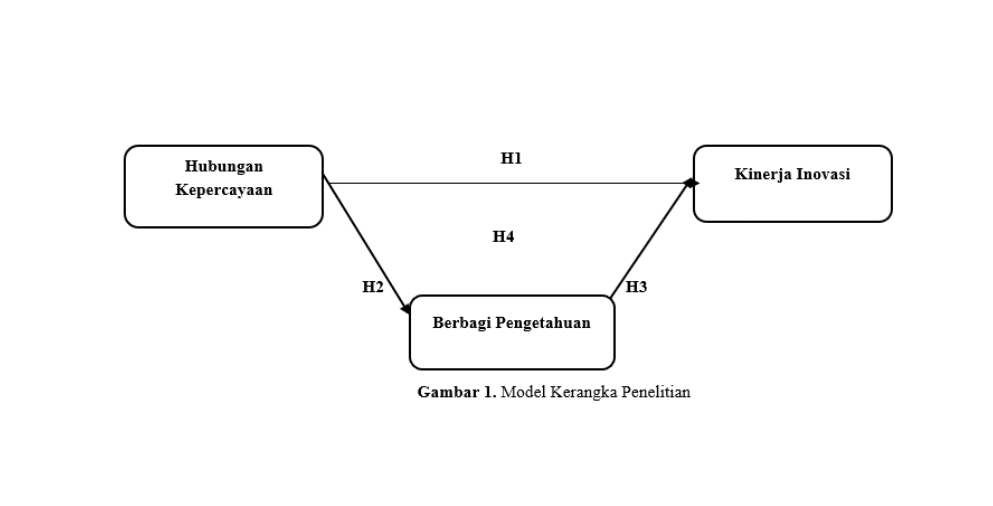
Sektor ekonomi perusahaan dengan fokus pada penciptaan dan penyaluran produk yang berkaitan dengan kreativitas dan ide memiliki kontribusi dalam menentukan keberhasilan kinerja inovasi. Selain itu, hubungan kepercayaan merupakan landasan terciptanya berbagi pengetahuan antar karyawan sehingga kinerja inovasi meningkat. Tujuan penelitian ini adalah untuk menganalisa hubungan kepercayaan dan kinerja inovasi melalui berbagi pengetahuan. Penelitian ini menggunakan metode pengolahan data kuantitatif dengan menggunakan statistik Smart PLS 4.0. Sampel penelitian ini sebanyak 113 responden dari usaha mikro, kecil, dan menengah (UMKM) pada sektor Batik di Yogyakarta. Hasil analisis menunjukkan bahwa hubungan kepercayaan memiliki pengaruh positif terhadap kinerja inovasi, hubungan kepercayaan secara positif mempengaruhi berbagi pengetahuan, berbagi pengetahuan secara positif mempengaruhi kinerja inovasi, dan berbagi pengetahuan secara positif memediasi pengaruh hubungan kepercayaan terhadap kinerja inovasi.
##plugins.themes.academic_pro.article.details##

This work is licensed under a Creative Commons Attribution-NonCommercial 4.0 International License.
LPPM Politeknik Piksi Ganesha Indonesia
References
Anderson, J. C., & Narus, J. A. (2018). Business market management: Understanding, creating, and delivering value. Pearson.
Astuti, D., & Sari, M. R. (2023). Nilai-nilai sosial dalam praktik bisnis UMKM batik Yogyakarta. Jurnal Sosial Ekonomi Kreatif, 5(1), 44–56.
Baah, C., Acquah, I. S. K., & Ofori, D. (2022). Exploring the influence of supply chain collaboration on supply chain visibility, stakeholder trust, environmental and financial performances: a partial least square approach. Benchmarking, 29(1), 172–193. https://doi.org/10.1108/BIJ-10-2020-0519
Baah, C., Opoku Agyeman, D., Acquah, I. S. K., Agyabeng-Mensah, Y., Afum, E., Issau, K., Ofori, D., & Faibil, D. (2022). Effect of information sharing in supply chains: understanding the roles of supply chain visibility, agility, collaboration on supply chain performance. Benchmarking, 29(2), 434–455. https://doi.org/10.1108/BIJ-08-2020-0453.
Badan Pusat Statistik Daerah Istimewa Yogyakarta (2023). Profil UMKM Daerah Istimewa Yogyakarta Tahun 2023. Badan Pusat Statistik Provinsi DIY.
Barney, J. B. (1991). Firm resources and sustained competitive advantage. Journal of Management and Business Review, 17(1), 99–120. https://doi.org/10.1177/014920639101700108
Brahm, F., & T. (2016). Trust and contract design: Complementary or substitutes? Journal of Business Research, 69(11), 5022–5027. https://doi.org/10.1016/j.jbusres.2016.04.073
Chin, W. W. (1998). The partial least squares approach to structural equation modeling. Lawrence Erlbaum Associates.
Civelek, M. E., & Çemberci, M. (2020). The Effects of Trust and Capability in Supply Chain on Firm Performance through Supply Chain Agility and Collaborative Advantage. Journal of Business Research - Turk, 12(1), 440–453. https://doi.org/10.20491/isarder.2020.854
Delbufalo, E. (2017). Exploring the relationship between trust and supply chain collaboration: A quantitative study. International Journal of Production Economics, 193, 73–84.
Dhanaraj, C., Lyles, M. A., Steensma, H. K., & Tihanyi, L. (2004). Managing tacit and explicit knowledge transfer in IJVs: The role of relational embeddedness and the impact on performance. Journal of International Business Studies, 35(5), 428–442.
Dyer, J. H., & Singh, H. (1998). The relational view: Cooperative strategy and sources of interorganizational competitive advantage. Academy of Management Review, 23(4), 660–679. https://doi.org/10.5465/amr.1998.1255632
Fitriani, I., & Sugiharto, T. (2020). Inovasi teknologi produksi batik dan dampaknya terhadap peningkatan daya saing UMKM. Jurnal Teknologi Dan Inovasi Industri, 12(2), 89–100.
Fornell, C., & Larcker, D. F. (1981). Structural Equation Models with Unobservable Variables and Measurement Error: Algebra and Statistics. Journal of Marketing Research, 18, 382-388. http://dx.doi.org/10.2307/3150980
Fu, S., & Huo, B. (2017). The impact of trust and contract on innovation in supply chain relationships. Industrial Marketing Management, 63, 50–60.
Ghozali, I. (2021). Partial Least Square (PLS): Konsep, Teknik dan Aplikasi dengan SmartPLS 4.0. Badan Penerbit UNDIP.
Grant, R. M. (1996). Toward a knowledge‐based theory of the firm. Strategic Management Journal, 17, 109–122.
Hair, J. F., Hult, G. T. M., Ringle, C. M., & Sarstedt, M. (2019). A Primer on Partial Least Squares Structural Equation Modeling (PLS-SEM). Sage Publications.
Hair, J. F., Risher, J. J., Sarstedt, M., & Ringle, C. M. (2021). When to use and how to report the results of PLS-SEM. European Business Review.
Handayani, R., Kurniawan, A., & Sutopo, W. (2022). Collaborative innovation network in batik industry: Empirical study in Yogyakarta. Jurnal Manajemen Dan Inovasi, 13(1), 25–36.
Inkinen, H. (2016). Review of empirical research on knowledge management practices and firm performance. Journal of Knowledge Management, 20(2), 230–257. https://doi.org/10.1108/JKM-09-2015-0336
Jermsittiparsert, K., & Pithuk, L. (2019). Exploring the link between adaptability, information technology, agility, mutual trust, and flexibility of a humanitarian supply chain. International Journal of Innovation, Creativity and Change, 5(2), 432–447.
Khairunnisa, A., & Fitrani, E. (2014). Peran hubungan kemitraan dan budaya lokal dalam inovasi UMKM batik Yogyakarta. Jurnal Ekonomi Kreatif Dan Inovasi Daerah, 3(1), 112–124.
Kmieciak, R. (2021). Trust and innovation in SMEs: The mediating role of knowledge sharing. Management Research Review, 44(5), 731–747.
Lee, Y., & Wong, K. Y. (2020). Knowledge management performance measurement: A review. Journal of Knowledge Management, 24(5), 1031–1057. https://doi.org/10.1108/JKM-11-2019-0648
Leung, A., Zhang, Z., & Fu, P. (2021). Trust and groupthink in Asian innovation teams: Double-edged effects of social harmony. Asia Pacific Journal of Management, 38(2), 521–543.
Lin, Y. H., & Chen, Y. S. (2017). Determinants of green competitive advantage: the roles of green knowledge sharing, green dynamic capabilities, and green service innovation. Quality and Quantity, 51(4), 1663–1685. https://doi.org/10.1007/s11135-016-0358-6
Liu, H., Liu, W., & Wang, Y. (2020). The dark side of trust in knowledge sharing: A cultural perspective. International Journal of Information Management, 53, 102118.
Liu, Y., Li, Y., & Zhang, M. (2022). Trust and innovation in small enterprises: Evidence from emerging economies. Journal of Small Business Management, 60(2), 345–367.
Ma, Z., Humphreys, J. H., Qi, L., & Wang, K. (2008). Knowledge sharing in Chinese con struction project teams and its affecting factors. Chinese Management Studies, 2(2), 97–108.
Men, F., Yaqub, R. M. S., Yan, R., Irfan, M., & Haider, A. (2023). The impact of top management support, perceived justice, supplier management, and sustainable supply chain management on moderating the role of supply chain agility. Frontiers in Environmental Science, 10(January), 1–19. https://doi.org/10.3389/fenvs.2022.1006029
Morgan, R. M., & Hunt, S. D. (1994). The commitment-trust theory of relationship marketing. Journal of Marketing, 58(3), 20–38. https://doi.org/10.1177/002224299405800302
Nonaka, I., & Takeuchi, H. (1995). The Knowledge-Creating Company: How Japanese Companies Create the Dynamics of Innovation. Oxford University Press.
Nuraini, R., Mustofa, A., & Harjanti, S. (2021). Kolaborasi rantai pasok dalam meningkatkan inovasi UMKM batik. Jurnal Logistik Dan Rantai Pasok, 9(1), 41–52.
Nursyamsi, F., & Anggraini, D. (2023). Kesiapan inovasi UMKM batik menghadapi transformasi digital. Jurnal Inovasi UMKM, 2(2), 77–88.
Pham, T. K. T. (2020). Organization justice, knowledge sharing and employees’ innovative behavior. Employee Relations, 42(6), 1492–1510.
Polanyi, M. (1996). The Tacit Dimension. Routledge & Kegan Paul: London.
Prajogo, D. I., & Sohal, A. S. (2003). The relationship between TQM practices, quality performance, and innovation performance. International Journal of Quality & Reli Ability Management, 20(8), 901–918.
Prasetyo, H., & Subagyo, R. (2021). Pengaruh berbagi pengetahuan terhadap inovasi digital UMKM kreatif. Jurnal Ekonomi Dan Kewirausahaan, 19(1), 13–22.
Rahmatika, D. F. (2024). EMPLOYEE LOYALTY: PERAN TRUST IN MANAGEMENT DAN PEERS DENGAN MEDIASI EMPLOYEE SATISFACTION. Publik: Jurnal Manajemen Sumber Daya Manusia, Administrasi Dan Pelayanan Publik, 11(1), 288–302.
Santos, C., Coelho, A., & Cancela, B. L. (2024). The impact of greenwashing on sustainability through green supply chain integration: the moderating role of information sharing. Environment, Development and Sustainability. https://doi.org/10.1007/s10668-024-05009-2
Sari, T. M., & Kurniawati, D. (2022). Peran berbagi pengetahuan terhadap inovasi produk UMKM batik di Jawa Tengah. Jurnal Inovasi Ekonomi Dan Bisnis, 10(2), 98–110.
Scott-Kennel, J., & Saittakari, I. (2020). Knowledge sharing in international business networks. International Business Review, 29(2), 101–112.
Shan, J., Fu, W., & Zheng, C. (2023). Knowledge sharing, trust, and innovation performance: Evidence from Chinese manufacturing SMEs. Technological Forecasting and Social Change. https://doi.org/10.1016/j.techfore.2023.122312
Shin, J., Yoo, S., & Kwon, S. (2020). Trust in supply chain collaboration and innovation performance. Industrial Management & Data Systems, 120(5), 845–864.
Song, M., Yang, M. X., Zeng, K. J., & Feng, W. (2020). Green Knowledge Sharing, Stakeholder Pressure, Absorptive Capacity, and Green Innovation: Evidence from Chinese Manufacturing Firms. Business Strategy and the Environment, 29(3), 1517–1531. https://doi.org/10.1002/bse.2450
Thanki, S., & Thakkar, J. (2018). Interdependence and coordination in supply chain: A review. Benchmarking: An International Journal, 25(4), 1010–1033.
Utami, A. P., Emilia, N., Trisakti, U., & Utami, A. P. (2024). Pengaruh Green Human Resource Management, Green Innovation, Perceived Organizational Support Dan Risk-Taking Terhadap Corporate. Jurnal Manajemen Sumber Daya Manusia, 11(1), 314–330.
Wahyuni, T., & Riyanti, B. P. D. (2023). Pengaruh kepercayaan terhadap intensi berbagi pengetahuan dalam jaringan UMKM kreatif. Jurnal Psikologi Industri Dan Organisasi, 12(1), 65–75.
Widodo, A., & Purnomo, H. (2021). Inovasi dan daya saing UMKM batik di era globalisasi. Jurnal Ekonomi Dan Bisnis, 15(2), 55–67.
Wolor, C., Eranza, D., Rababah, M., Nurkhin, A., & Hoo, W. (2024). The impact of interpersonal trust development on maintaining business sustainability: A case study of Aceh Gayo coffee from Sumatera, Indonesia. Journal of Infrastructure, Policy and Development. https://doi.org/10.24294/jipd.v8i6.3947
Wulandari, A. (2020). Strategi pengembangan UMKM batik di Yogyakarta dalam perspektif ekonomi kreatif. Jurnal Ekonomi Lokal Dan Terapan, 9(1), 13–23.
Yang, C., Chen, L. C., & Hao, Y. (2019). Knowledge sharing and innovation performance: The role of absorptive capacity and dynamic capabilities. Journal of Knowledge Management, 23(9), 1753–1778.
Yaroson, E. V., Chowdhury, S., Mangla, S. K., & Dey, P. K. (2024). Unearthing the interplay between organisational resources, knowledge and industry 4.0 analytical decision support tools to achieve sustainability and supply chain wellbeing. Annals of Operations Research. https://doi.org/10.1007/s10479-024-05845-5
Yuliana, E., & Rachmawati, I. (2021). Analisis hambatan inovasi pada UMKM batik: Studi pada Kabupaten Bantul. Jurnal Inovasi Dan Kewirausahaan, 10(1), 20–30.
Zaid, A., Sleimi, M., Saleh, M. W. A., & Othman, M. (2023). The mediating roles of knowledge transfer and supply chain quality management capabilities on organisational performance. VINE Journal of Information and Knowledge Management Systems, 53(6), 1041–1064. https://doi.org/10.1108/VJIKMS-12-2020-0226